 Helping People... To Help Themselves
Helping People... To Help Themselves
Helping People... To Help Themselves
Our key strategic orientation is to build and strengthen
**People’s Organizations (PO)** and **People’s Institution (PI)**
which can work collectively on various issues faced by the
communities towards sustainability. Through various methods
and processes, **YRA** generates awareness among the needy and
poor communities. We demonstrate for educating and training
people for new selected development initiatives. **Attitude
change** is the most critical area to intervene, where in YRA
focuses. YRA believes that "**Facilitating Change Process**" is
the key of all development interventions and practices the
same....
Local potential youth and women are
trained in
various technical and scientific areas under the most
experienced/ certified experts in respective fields such
as youth development, education, health, employment,
livelihood, women empowerment, tribal empowerment,
sustainable agriculture, WASH, goatery, poultry, soil
and water conservation etc. Community engagement is
ensured in all interventions. Development process gets
multi-fold speed if the beneficiary groups are organized
and involved in their Pos and PIs. with ownership and
sustainability.
We work with them because they are traditionally and
culturally deprived, remained vulnerable, less educated
and exploited, with no exposure for better life. They
need facilitation, support, make aware of their needs
and work collectively to fulfil those needs.
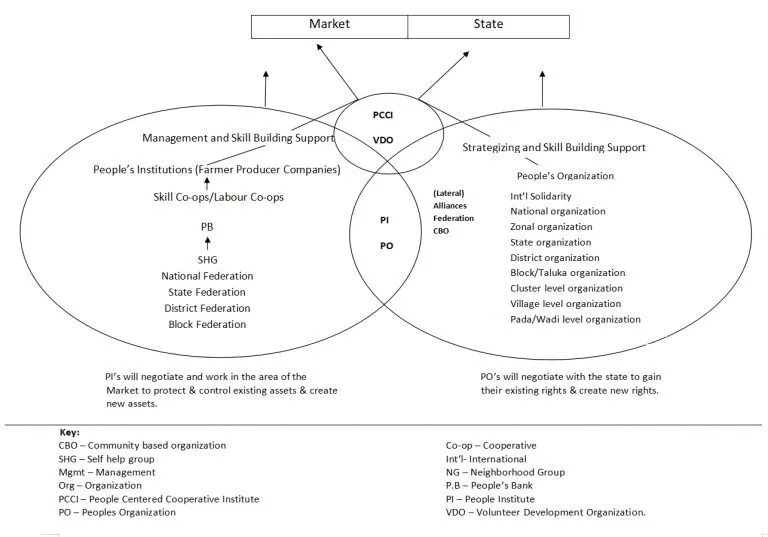
Experience has taught us that these organizations/institutions/committees play a very important role in the success of any rural livelihood initiatives. This experience has been echoed by various other NGOs/CSOs. **People’s Organizations** (FPOs, Mahila Vikas Parishads etc) are collectives that focus on rights-based issues. **People’s Institutions** (SHGs, WUGs etc.) focus on resources and their management, and have a mandate that emphasizes formalized legal, financial and practical implementation and actions (for example, opening a bank account or forming a business collective). Thus, the type of support provided by POs or PIs varies according to their purpose and structure. One block level federation of these groups will be formed as a PO (People’s Organisation) and slowly this federation will be shaped into a PI (Peoples Institution’s) so that the continuity of the PO remains, as also the scope to expand will be possible. Turning the PO into a PI may not remove its role as a PO. But the shape of the PI will strengthen and mainly sustain the model of PO and PI—that is the real collective strength of the poor and marginalized communities.